
AI and Agent Permissions
Configure AI and Agent permissions through global user roles to control feature access, including AI Chat, agent creation, and workspace sharing
AI permissions are part of the global user roles. They determine which features a user can access in the AI section.
For agents, there's also a distinction between agent access and context access. To run an agent in a task or project, you need both permissions.
Important: An agent is not a user. It doesn't have its own awork role or permissions. Every run takes place on behalf of a responsible user.
What AI permissions are available?
Kein Zugriff
When Kein Zugriff is enabled for a general permission role, users can't use AI Chat or agents. The AI menu item won't appear in the main menu, and the AI Chat sidebar can't be opened with Cmd/Strg + I.
These users can still be part of the AI subscription. This setting controls access, not billing.
AI & Agents verwenden - ohne Teilen
This is the default setting.
Users can:
- Use AI
- Use agents
- Create their own agents
- Create their own skills
Their own agents and skills can't be shared with the Workspace Library.
AI & Agents verwenden - in Library teilen
In addition to the default permissions, users can share agents and skills with the Workspace Library.
Agent access permissions
Agents have the following permissions: Keine, Lesen und verwenden, and Verwalten.
Keine
Users can't find, open, configure, or run the agent.
Historical agent activity and context-related threads may still be visible if the user has permission to view the relevant task or project context.
Lesen und verwenden
With Lesen und verwenden, users can:
- Open the agent and view its details
- Run agents, if they also have write access to the specific task or project context
- Use linked skills, including private agent skills
- Use linked connectors, if the responsible user's connection is available
Read permissions don't allow users to make changes to the agent configuration.
Verwalten
Verwalten includes all read permissions and also allows users to edit the agent and change its settings or sharing permissions.
This includes configuration, versions, avatar, sharing, memory, skills, connector, workflows, schedules, and archive status.
How are agent permissions assigned?
An agent can be shared with the entire workspace, teams, or individual users.
- Creators and workspace admins: Always have Verwalten permission for the agent
- Multiple shares: The highest permission applies
- New agents: Initially, only creators and workspace admins can access them
- No additional permission needed: Read access allows users to use the agent
Which permission do I need?
| Action | Required permission |
|---|---|
| Create an agent | Authorized internal workspace user with agent access |
| Open an agent | Agent Lesen und verwenden |
| Edit or share an agent | Agent Verwalten |
| Start a standalone thread | Agent Lesen und verwenden |
| Run an agent in a task or project | Agent Lesen und verwenden + write access to the specific context |
| Mention an agent in a comment | Agent Lesen und verwenden + write access to the commented context |
| Read an existing task or project thread | Read access to the specific context |
| Continue a task or project thread | Agent Lesen und verwenden + write access to the specific context |
| Stop a context-related run | Write access to the specific context |
| Stop a standalone run | Creator only |
| View agent activity and run history | Read access to the task or project context |
| Create, edit, delete, or manually start a schedule | Agent Verwalten + required access to the selected context |
AI thread permissions
AI threads can remain private, be shared directly with other people, or be linked to a project or task. Different access rules apply depending on the type of thread.
Directly shared private threads
Private threads can be shared directly with individuals, teams, or the entire organization.
The thread owner or someone with Verwalten permission can set up sharing and choose access permissions.
Directly shared threads have two permission levels:
-
Read: The user can view the full conversation history, as well as shared attachments, generated files, and saved data. Future replies are shared too.
-
Manage: The user can also send messages, invite more people or teams, change sharing settings, rename the thread, and delete it.
To send messages, a user needs both Verwalten permission for the thread and access to the AI agent being used. Sharing a thread doesn't grant access to the agent itself.
When someone is individually invited with Verwalten permission, they automatically join the thread if they can use the agent. People who get Verwalten permission through a team or the entire organization must first click Thread beitreten themselves.
Workspace admins don't automatically get access to private AI threads through their administrator role. They also need to be granted access.
AI thread permissions at the project level
The relevant project and task permissions still apply to AI threads linked to a project.
The project-specific Projekt-AI-Threads permission determines whether users can see a project's AI threads. There are two options:
-
Lesen: The user can see all AI threads for the project.
-
Keine: The user can't see any AI threads for the project.
There's no separate edit permission for project AI threads.
To actively participate in a project thread and send messages, a user also needs:
-
Agent: Lesen und verwenden.
-
Context: Write access to the specific project or task.
Users can actively participate in the conversation only once these requirements are met.
Comparing direct thread sharing and project permissions
For directly shared threads, Lesen or Verwalten determines what recipients can do.
For project threads, visibility is controlled by project permissions. To actively use a thread, users also need access to the agent and the relevant context.
The two permission models are separate. Sharing a private thread doesn't automatically grant access to the agent being used. Likewise, access to an agent doesn't automatically give people access to every private thread.
👉 Learn more: Share AI threads and Link AI threads to projects.
Agent activity
Agent Aktivität shows an agent's involvement in tasks and projects. It does not grant any permissions on its own, and it does not make an agent a task member or project member.
If a thread is deleted, its activity and run history are retained. A later run creates a new thread if no thread is available.
Adjusting permission levels for AI & Agents
Admin permissions are required.
Setting AI permissions in the general permission role
-
Open the settings (gear icon at the bottom left of the main menu).
-
Go to the Admin category and select Rechtemanagement from the menu.
-
Open the Allgemeine Berechtigungsrolle.
-
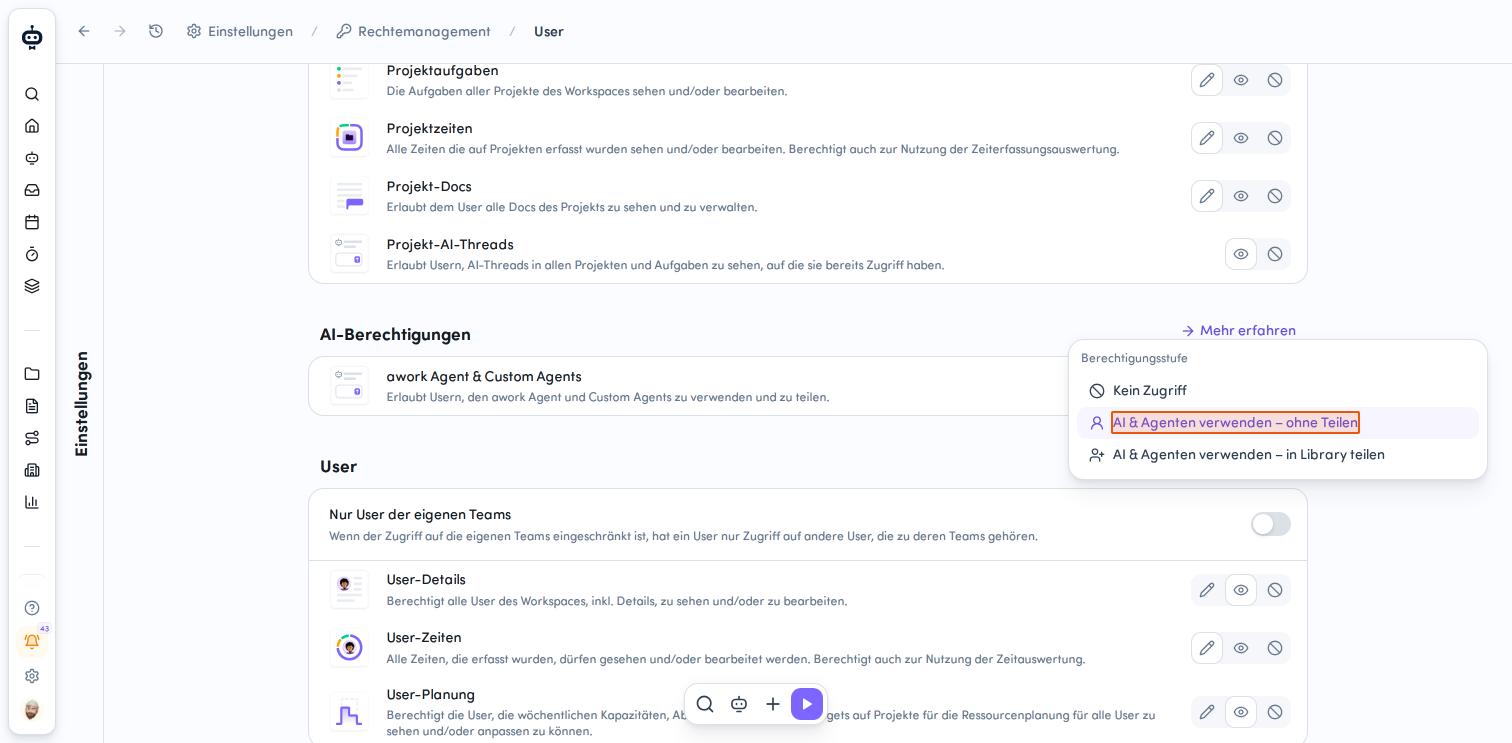
Scroll to the AI-Berechtigungen section. There you'll find the permission for awork Agent & Custom Agents, with a dropdown on the right side of the row.
-
Open the permission dropdown
Click the dropdown next to awork Agent & Custom Agents. It shows the currently selected permission level and has a small arrow icon indicating that more options are available. -
Select a permission level
The dropdown menu that opens has the heading Berechtigungsstufe and offers three options:- Kein Zugriff: Users can't access AI features or use the awork Agent or Custom Agents.
- AI & Agenten verwenden – ohne Teilen: Users can use the awork Agent and Custom Agents, but can't share them with others.
- AI & Agenten verwenden – in Library teilen: Users can use the awork Agent and Custom Agents, and share them with others in the Library.
-
Select the option you want
Click the permission level you want to set for users. The selected option is applied immediately and displayed in the dropdown.
AI permissions are now configured for the user role. The changes take effect immediately for all users with this role.
Setting permissions for project AI threads in the project-specific permission role
-
Open the settings (gear icon at the bottom left of the main menu).
-
Go to the Admin category and select Rechtemanagement from the menu.
-
Open the Projektspezifische Berechtigungsrolle.
-
Select one of the two available options for Projekt-AI-Threads:
- Lesen
- Keine
Who is the responsible user?
Every agent run has a responsible user. Their awork permissions, personal skills, and personal connector connections are used for the run.
- Direct run or follow-up: The user who selects Run agent or sends the message is responsible.
- Agent mention in a comment: The user who adds the agent mention is responsible.
- Automatic schedule: The schedule's responsible user remains responsible.
- Run schedule now: The schedule owner remains responsible. The user who selects Run now is also recorded as the triggering user.
- Delegated or sub-agent run: The run inherits the responsible user and triggering user from the parent run.
If a user saves or edits a schedule, they become responsible for future runs.
Important: If the required permissions are missing, the user is inactive, or the permission can't be checked, the run is rejected or stops at the next protected boundary.
Permissions during an agent run
A key principle is that an agent never gets more permissions than the user it's acting on behalf of.
An agent has no awork permissions of its own. It always acts on behalf of the user. If a user isn't allowed to perform a particular action in awork, their agent can't perform it either.
Every run is performed on behalf of the responsible user who starts it. The agent can therefore only perform actions that this user is authorized to perform.
This means that if you don't have permission to edit a task or project, the agent can't make changes there either. In that case, the agent is limited to read-only access.
This applies to:
-
Agent runs in projects
-
Agent runs in tasks
-
Scheduled agent runs
-
Agent runs through automations
For a scheduled run or an automation, the agent uses the permissions of the user who set up the run.
Only this user can edit the schedule. Depending on their permissions, other users may be able to access or delete the run, but they can't automatically change its instructions.
Important: Existing sharing and confirmation rules still apply. Agents don't bypass permissions or confirmations.
In short: Anyone with access to a task or project can start an agent run for it. Changes are only possible if the user has the appropriate editing permissions.
An agent run can still be useful even without editing permissions, for example for a health check, a summary, or a quick translation.
The same principle applies to connectors. For example, if a user connects their Google account, an agent using that connection can only perform actions that are possible through that Google account.
If an agent is shared with another user, it uses that user's own connected accounts and permissions.
An exception applies when a specific account or credentials are deliberately embedded in an agent.
Permissions for general AI settings
Different permissions are required to manage workspace-wide AI settings:
- Models and workspace context:
Access to Workspace-Einstellungen and at least the AI & Agenten verwenden – ohne Teilen permission level under AI-Berechtigungen in the Allgemeine Berechtigungsrolle - Usage & activity: Admin permissions
- Library: At least the AI & Agenten verwenden – ohne Teilen permission level under AI-Berechtigungen in the Allgemeine Berechtigungsrolle
What permissions apply to external users?
External users don't have access to a project's AI thread list.
In a project, they can't:
- See the project's AI tab
- Assign agents in the project
- Mention an agent in a comment
- Link their own AI thread to the project
They can still use AI in their own workspace and use a project as context, as long as they have the appropriate permissions.
An AI thread created by an external user in their own workspace stays there and counts toward their own quota. It can't be transferred to a project in another workspace.
FAQ
Is Agent read access enough to start an agent in a task?
No. You also need write access to the specific task or project context.
Does an agent have its own awork permissions?
No. An agent doesn't have its own awork role. Each run uses the permissions of the responsible human user.
Can workspace admins read other people's standalone threads?
No. Admin privileges don't override the privacy of a standalone thread.
What happens if the responsible user no longer has permission?
The run is denied or stops at the next protected boundary.
 Powered by happysupport.ai